Sunday, November 24, 2013

Bantiox Astrid!

Astrid left Mercedes on Friday and it’s rather sad here now.

Few words from Astrid before leaving Mercedes:
“The beginning was a bit difficult for me as I wasn’t speaking Spanish fluently, it was my first experience in volunteering and spending so much time outside France. There were so many people, hot weather and I felt lost. The first week I had to get used to hot weather, food and I was really afraid of animals/insects, especially spiders. But now I know that you can get used to everything (even if you have arachnophobia you can live with spiders under one roof). The children did a very nice welcome and accepted me from the first day. The people in general were very nice for me. Little by little we started working together with Ewa and we got used to living here and every day life was just continuing naturally.
It was nice to work with Ewa, share ideas, feeling as a part of the team and doing things together but also being responsible for some activities.
The best moments were when seeing the kids laughing. Even though they are lacking many things they seem soooo happy. The most incredible is that they spread the happiness easily to everyone around like an “air diseases” and even if you were angry for them a minute ago now they make you happy and you love them with all your heart.
There are some issues/things to improve in Li Ch’utam as it is still a developing organization. The good thing is that it’s a small, grassroots organization and works with people directly and we can see effects of our work quickly (sometimes we see the kids progress even week to week).
I liked to see that there are people especially young people here who want to be involved in the life of their community and I liked a lot to talk and spend time with them.
For me in general it was a very nice experience to meet people, other culture even though it was sometimes difficult to get used to some things like always waiting for people. J But finally I will have a very nice and only positive memories out of this experience. “
Astrid

Thank you Astrid for your presence in Nueva Mercedes, your excellent work with kids, patience, ideas and commitment to the organization. 


I really loved to work with you as I could always count on you and share my thoughts. Living together and spending free time with you was a great pleasure. I hope that you’ll be in touch with Li Ch’utam and can come back one day to see the changes in the community. I remember when at one of the meetings one mother said: “Dile a Astrid que no se vaya!”. Debora, one of our young volunteers said today that she couldn’t sleep Friday night and was crying because she got used to Astrid so much and she treated her like an older sister. 

Tuesday, November 19, 2013

Dodo's first impressions

 Dodo is on board since one week.
“When I took my last flight from Houston to Guatemala City, I was really stressed, because I knew, things would be different, but when I finally left the airport, I thought it was Napoli instead of Guate. But still this isn't Europe, which I learned very fast, because if something works in Napoli, then it's the road building but in Guate the roads and the drivers aswell are very shitty. And if you are used to European roads and travel on those potholed dirt roads for many hours, you get a feeling of being at the and of the world and to be honest, this feeling didn't change by now, because I think this really is the end of the world. But I like the end of the world pretty much, because it's very pretty. Like the streets, very dirty but somehow awesome. Even though my Spanish is not the best, I am able to communicate with the kids already and playing soccer is also an international language, that everyone gets. I'm looking forward to come back here, after I improved my Spanish in Antigua for a month, so I can exchange more than “donde esta la pelota” or “no tocar mi cabello sin preguntar” and grin silly, when I don't get a word again. But by now I'm really glad to be here, sweating my soul out of my body when I make a step, instead of being in the shitty weather, that Hamburg provides at the moment :)
Dodo

Wednesday, November 6, 2013

Holiday activities

It’s been already more than 3 weeks of holiday activities in Nueva Mercedes. For morning activities sometimes we had no kids so we have decided to reschedule he activities a bit, so on Monday and Friday there are no activities in the morning and the grades from that days join the other days (pre-primary comes with first grade on Tuesday and fifth and sixth grade comes with third and fourths on Thursday). Anyway for morning activities we have maximum 10 kids, which is quite good because we can attend each kid and not so good in the same time because we reach only around 15-30 kids every week with the morning activities. So far we had two weeks of travelling around the world visiting Guatemala, Poland, France, China, Tanzania, showing photos and describing different customs, preparing flags of different countries, dancing polonez, merengue, doing Chinese hat and African mask. 


The two following weeks are about nature, so we talk about water: seas, lakes, rivers etc, about water animals and the usage of water, it’s importance and disasters. The same scheme is about wind and earth, including ecology issues, always with manual activities. Kids like a lot manual activities we do with the topics, there are 2 kids who come 2 or 3 times a week for the same activity and each time they are happy to do the same manual activity!

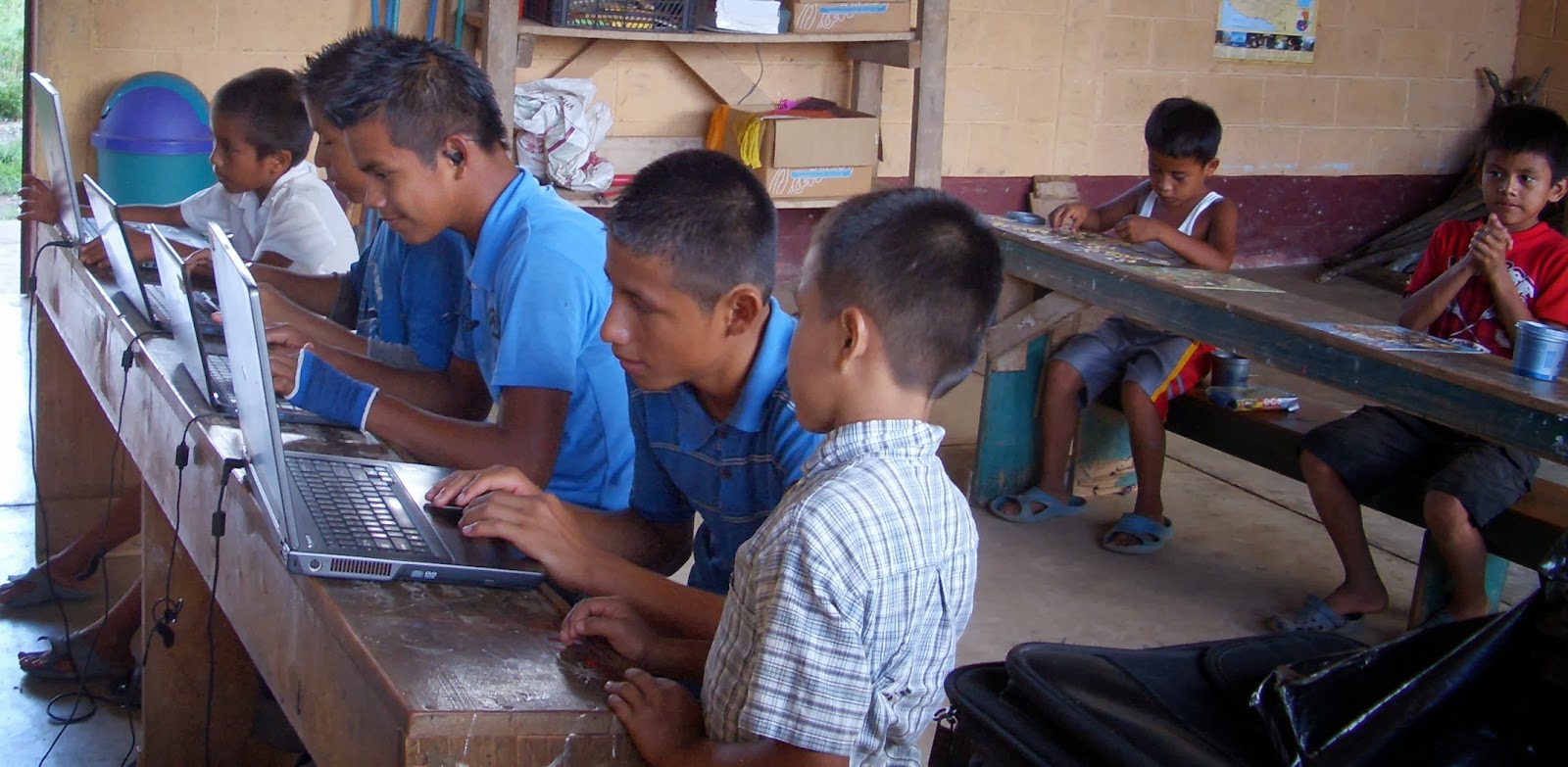
The schedule of afternoon activities did not change. Monday and Friday we have computer classes. The good thing is that we have new participants (from families we have visited recently) and these are young girls (not attending the school any more (age 14 and 15). So they were working on computer for the first time last week. We showed them a bit of basics of computer usage and Word/Libre office so that they can learn a bit how to write. We are also discovering the games available in Edubuntu and trying to put different game each time, adjusting to kid’s level of literacy. We plan to put each time a “topic”, for example writing or math or memory etc. so that each kid does something connected with the “topic” but on her/his level.


At literature classes (Tuesday and Thursday) we are progressing with Lester, the kid coming every time who cannot read and write, he already knows almost all the alphabet letters and is practicing it on computer classes as well.


There are more kids from fifth and sixth grade and at the age of high school but not attending school coming for both literacy and computer classes. All together there are almost 50 kids/young people coming for our classes. That means we are reaching almost one third of the kids in the community with our activities. Many kids cannot come because they are working, the older once in the plantation and the youngers at home, some kids live a bit far from school and cannot come alone but still for sure that we could have at least 20-30 more coming.
The nicest view is of course Wednesday when we see 20 faces so naturally laughing watching a movie. J


Last Thursday the school ended officially. 


The sixth grade students had a more formal event (for the first time in this school). 


The teachers came two hours later than they should have as it was raining a lot those days and it was not possible to cross the river in Teleman (for the same reason we couldn’t go for shopping on Wednesday). The decoration and programme was prepared half an hour before the event and the event was 1,5 hour late (Guatemalan style :) ). We had our parts in this event: Astrid was IT person, responsible for the music, and I was a master of ceremony. It was not an easy task as we got this information, programme, music etc. 10 minutes before the start of it. But we were happy to help. The last words of the event belonged to Rony, teacher of the sixth grade who congratulated the students and wished them to continue studying.


Monday, October 21, 2013

Activities

Last Monday children here started holidays that will last until mid January. We have decided to run activities for them. Every day from Monday to Friday in the morning we have activities with different grade on the specific topic. For the first two weeks it’s “travelling around the world” where we talk about countries from different continents, showing photos, talking about differences comparing to Guatemala, food, dancing and doing crafts. The next two topics will be: “nature” with animals, plants and a bit of ecology, and “cultural activities” with art, theatre, sports etc. In the afternoon we have classes for everyone, Monday and Friday computer classes, with educational games, Tuesday and Thursday literature – reading books together with different exercises helping in understanding what is read, Wednesday movie watching. We have started on Monday, for the morning activities sometimes we have 10 kids sometimes no one is coming. 


When they come they are eager to learn and do the activities even though they are rather shy. In the afternoon there are much more kids coming (15-20). They like doing math or writing exercises on computers and the games we do apart. During literature classes we only do activities connected with reading and writing. Every child coming starts reading a book and we try to help if any problems. There are also some exercises like reading small texts and guessing what is described. All of the kids try to read and with those who don’t know reading and writing we seat apart showing them letters writing with them and trying to read simple words/books. There is one child already doing progress in our classes in reading.


To help us in the activities with small children but also to create young leaders in the community, we have asked few young people to help us in activities for kids. We have 3 people (one boy and two girls). They help a lot especially with 5-6 years old kids and first grade translating from Spanish to Q’eqchi everything we say. So the team of volunteers here actually has 5 people now: Astrid, Celia, Deborah, Ewa and Waldemar. All the volunteers are doing great job. :) We will have regular meetings where we plan to discuss past week and plan activities for the coming week. One of them is studying in high school in Telemán but the rest cannot continue studying because of lack of money. Wishing for REAL right to education for all kids…


Apart from work with kids and young people we have started talking with parents. We visit families to ask about what they know and think about Lichutam, what kind of activities they want us to do. We ask them about their kids, if they know Spanish on communicative level, can read, write and count. We also ask about their needs (of adults) and activities they propose for themselves. Families we have visited so far are quite positive about an idea of activities with adults. Some of them just want to join the ideas we have and others propose new once. We already have people interested in: writing, reading, Spanish, computer classes, gardening (vegetables mainly), weave, English, workshops on topics like health, children growing, home budgeting, addictions prevention, family planning. There are people in the village who could run some of these activities. It would be great to start the first of them this year.

Tuesday, October 15, 2013

New volunteers

Lichutam has 2 new volunteers onsite – Astrid, half French half Finnish, and Ewa, hundred per cent Polish.

After two weeks of travelling through Guatemala and Spanish course in Antigua, we finally arrived with Astrid to Nueva Mercedes two weeks ago. The views during the trip were stunning even though the trip was long and tiring. We both fell in love with pick-up half an hour trip from Telemán to Nueva Mercedes. We arrived in the evening and went straight to our house. It positively surprised us that it’s quite big and comfortable.

On Tuesday morning we went to school for the first time. It was a celebration of Children’s Day. We met teachers and children. Kids were playing instead of having classes. 


There was “piñata”, a big doll made of paper with lots of candies inside. Kids had to destroy it to eat candies. Parents together with teachers prepared lunch for the kids. Of course we were stars there as everyone wanted to know our names, talk to us, play with us etc., especially with Astrid’s blond fair hair. 


In the afternoon we had classes with kids. Only few of them came but were involved in classes, doing math exercises on computers and reading with us.


Andrew was presenting us to everyone we met, trying to explain who is who and whom should we contact in different situations.  People here are very nice and friendly, they are willing to help us in any situation.

A lot happened during the last two weeks:
- we had visits of many pets in the house - few scorpions, many spiders, even one tarantula, small snake – now we are not even surprised when we see them J
- we got used to the hot weather a bit but first days were rather difficult
- things/events here are never on time and for us at the beginning it was difficult to handle it; now we just try to do our stuff while waiting J
- we had professional tortilla lesson by Celia (14 years old) and her sister (8 years old)
- on Sunday we went with kids to swim in the nearby river; cold water and hot weather together with beautiful view made it a great time spent with kids


- we were invited to the Birthday Party of one of the teacher’s son (3) and we had a possibility to try home made food - chicken soup, tamal, tortilla, rise, and a dish made of chicken blood (very interesting taste)
- we’ve met owners of the plantation in Nueva Mercedes, a very nice engineer working here,
people from the nearby village, also international volunteers who stay there working with kids, garden and construction
- last Friday, we went to Telemán for the event prepared by High school students about Maya culture; traditional dances, music (including playing marimba, Guatemalan traditional instrument), clothes, imitations of houses with decorations typical for Maya people, food prepared by the students – perfect end of the first two weeks and the best start to know Maya culture; of course we were taking pictures of the houses and students in their traditional clothes and people were taking pictures of us J
- Q’eqchi – it is very different from Spanish and quite difficult to pronounce; however we try hard to learn some words and we see that people appreciate it when we can at least say words like “bantiox” (thank you) or “masa’la chol” (how are you); so we keep trying. J

Andrew left last Saturday and I think it was a sad day not only for him but for many people in the village. It’s strange to be here without him. Who’s going to play guitar and sing every night, wake us up with breakfast ready, prepare delicious and (very) spicy food, teach us how to make tortillas, explain again and again who is who? It seems that now we have to start building our own female life here. J

Monday, September 16, 2013

Fighting Illiteracy

To this day I recall quite vividly my first day at Nueva Mercedes school back in February. Quite nervous and soft-spoken—uncharacteristic of myself--I decided to spend the day with the second grade, as I find children in this age group to be more often easy-going, compared to hormonal fifth and sixth graders. One of my first simple acts of assistance to Instructor Marta consisted of me passing out chapter books to the children, saying hello, repeating my name endlessly, and then walking around the room and listening to them read, sometimes helping them sound out a long word. Discovering that the majority of the class could sound out most of the words and read out-loud (sometimes to a point of obnoxiously yelling), my first relieving thought was, “Phew, at least they know how to read.” However, this conclusion I would come to discredit in time, as I have discovered the school, the community, and the entire region is plagued by illiteracy.

Upon realizing that almost all of the children-- grades 1 to 6--were reading in the exact same lifeless, monotone voice, even during sentences with question marks, exclamation points, and quotations, I sensed that something was inherently wrong. After examining closely the teaching methods in first and second grade I concluded that the teachers had been successful in implementing the phonics method of teaching reading but have failed in instructing the children to the convert the letters' phonetics into comprehensible written language. Considering the undeniable importance of literacy being at the basis of education, as well as its service as an invaluable tool to many children who will finish school after sixth grade and begin working, I say if a school should give a child anything it must be the ability to decipher text.
 

In a lecture held one day in the third grade, Instructor Elda discussed the problems of illiteracy having negative impacts in the communities of Guatemala. To make her point further clear, she asked the children in the room to raise their hands if their parent's knew how to read and write. In a class of twenty-five students, six raised their hands. Furthermore provoking, and a testament to the results of this exercise, in a study revealed in the national newspaper Presa Libre, the municipality of Panzos, where Mercedes is located, is red-flagged and identified as having the second highest percentage rate of illiteracy in the country (47.38%).

The numbers' are clearly daunting, however, we are going to fight this simply by planting seeds for the future and our solution to this is getting books inside the house for the kids to read. Whether it be due to cultural or financial reasons, currently the families of Nueva Mercedes do not own books therefore the children appear to be estranged to them. With hope of reversing this we have begun to provide books to the children via a small library system where they are given the opportunity to check-out a book for a number of days at a time to bring home or elsewhere. As of now we have forty books, varying in reading level and subject matter, and the plan is to increase this number substantially, diversifying as much as possible, including not only fiction but historical, scientific, and environmental topics. Operating for about three weeks now, it has become popular among a small group of students and I believe that we will see greater participation with the accumulation of more books.


We are currently writing a “Donation Call” similar to that which we made for our laptops to request books from individuals, as well as sharing our small campaign with our friends CampusTech and Empresarios por la Educacion in the city who both have expressed interest in helping promote our cause. With the summer approaching it will be a very straight-forward objective for Li Ch'utam to raise books for the 2014 school year and formally introduce it at the start of the school year to acclimate the children to the process.


 Of course, simply providing books will not improve the situation alone. It is going to take a great amount of joint effort between the volunteers and teachers, and with their evidently being lack of communication between the two parties, a common objective such as increasing literacy could be a means of bringing us closer together.

 “The more that you read, the more things you will know. The more that you learn, the more places you'll go.” 
                                                                                         -Dr. Seuss

Thursday, September 5, 2013

Two Pivotal Steps


Picking up where I left off in the most recent post, regarding primarily more interaction with the community and searching for what might be desired, I'd like to share two current goals that myself and the Li Ch'utam team have set up for ourselves in the coming weeks. First, we are in the midst of setting up interviews with a dozen or so families that either have children approaching the end of primary school, children already attending basico (the equivalent of middle school in the United States) and/or children eligible to attend basico but currently are not for a number of different reasons which will be shared throughout this posting. Second, we are on a mission to discuss with chauffeurs in Teleman potential price range of developing a round-trip Transportation System accessible to only basico students at a discounted fare.

A note for the readers: in Guatemala, free public education beyond 6th grade is not provided, therefore it becomes the responsibility of the families to incur the costs, which in a large number of cases unfortunately is beyond their means. Once I gain more information about the total costs of education I should be able to elaborate on educational investment hindrance.

The purpose of the first task is for one, to have a formal discussion with the parents about the realities of higher education, to hear what they have to say about the potential opportunity, and express our interests in continuing a dialogue with them to explore choices and possible outcomes. Already having multiple discussions with parents and young adults in Mercedes, Teleman and surrounding communities, the desire to continue studying is ubiquitous. Even a number of teachers I have spoken to passionately expressed their cravings for a university level of education, as they feel it would allow them to perform their jobs better, but like the families of Mercedes the costs are beyond their salaries (Note: Becoming a teacher in Guatemala does not require university level certification which perhaps explains the high number of under-qualified teachers.  Excuse my lack of proper citing and statistics, but I was sometime back informed of a privately funded study that revealed that nearly half of primary level school teachers cannot pass 6th grade level evaluations. Food for thought.) This all being said, there is a lot to sit down and talk about, even if there are no apparent solutions. Secondly, it will provide us with basic data, such as overall costs including uniform, transportation, food, and school supplies (obtained by parents who currently have children attending), and the maximum amount of money families would be willing and able to pay given there was some sort of potential subsidy.

The idea for the second task was proposed by past volunteer Michal Azarkiewicz while we were discussing possible scholarship opportunities for female students considering the ratio of boys to girls that attend basico in Teleman is relatively high, especially among the outside communities such as Mercedes. We have discovered that this disproportionate ratio is in part due to security issues, such as sexual harassment and in extreme situations, rape. One of the underlying problems of the whole issue is that basico school hours are from roughly 2 pm to 7 pm therefore the children must travel back to their communities via bicycle or pick-up truck in extreme darkness, evidently an unsafe atmosphere for a young lady. Upon becoming aware of this reality, Michal suggested that we open up a conversation with chauffeurs in Teleman (there being many) and try to arrange a fair compensation that will likewise become a positive addition to the typical school day of dozens of children trekking multiple kilometers on foot or bicycle in the blazing hot after-noon sun and dangerous pitch-black evenings.


The necessity to set up this proposed Transportation System became even more pressing after a discussion I held with our scholar-student Waldemar when he shared with me his most recent experience of fleeing from men who were trying to lure him into their vehicle while on his way home from school one evening of recent. Aware that there have been instances of “ransom” in the region, Waldemar dropped his bike (perhaps his most valuable possession other than himself) and sprinted into the nearby sugar cane plants and hid for nearly 30 minutes until they passed. Part of me wishes that his story was merely a child's nightmare enhanced by paranoia and embellishment, and at first I was equally surprised as I was horrified to hear of a such story in a place that appears to be so calm and distanced from the crime-infested city, but it is a clear message that something as simple as a couple pick-up trucks dropping exhausted children securely off at or near their homes must be devised and promoted as soon as possible.

Much more to be said  and done.  Stay tuned : )