Sunday, October 11, 2015

New team, new beginnings, new season's greetings

Marta completed her volunteership with Lichutam and left us in September. Since then, a new team has arrived! We are now the Fantastic Four of El Polochic Valley: Anne, from Germany, Georgia, from Greece, Patrick, an Irish gentleman, and Katerina leading the team.

Here are the our new volunteers' impressions of the first week.


A First Week in Polochic, by Patrick

My first full week of life at Lich'utam has just come to an end. And finished in style I might add. I'm the only male in the house, living with three girls from different parts of Europe. “So lucky” you might be thinking, and you might be right, but our notions of lucky might be slightly different!
As the only male I get my own bedroom, while the three girls share one large bedroom. For me that's pretty darn lucky.

At the end of last week, at the beginning of October, we all met each other over the space of three to four days. This was a nice touch; to start volunteering with people at the same time, to share the same experiences and to be able to talk about all the novel things as they occur to all of us, at the same time.

This week we spent our mornings in the classroom, acting as assistants to the teachers, or in my case, a very old student. I found my thirty one years of life experience close to useless when Anna, my teacher, started teaching in the indigenous language Quich'i. Even as she taught in Spanish, I noticed many of the fourth graders in my class spoke and wrote better Spanish than me. However in Maths, I excelled, I was able to move around the class, supporting the students with their maths formulas, equations, multiplications and fractions. Maths in my class has become the universal language.

Our school provides education for children from kindergarten to sixth grade. I'm helping the fourth graders. Fourth grade is a mix of ages. There are ten year olds and there are fifteen year olds. Many students struggle with literacy and are easily distracted in the classroom. The result is a classroom of students of different ages. In one case, a gentle fifteen year old boy has been passed out by his younger brother who is now thirteen and a grade above. I hope the elder passes his exams this week.

After school, we rest, cook lunch and return to the kids in the afternoon. They are always very happy to see us. We plan on doing activities with them to reinforce their literacy and maths, computer skills and personal growth. It should be an interesting, challenging but very positive summer.

To top of the first week, we four visited one of the Lich'utam founder's family members. We stayed on his farm for some rest and relaxation and saw the beauty of Polochic from the air. Soaring up into the sky in his two person flying trike was a treat I won't soon forget.  


My New Far Away Home, by Anne
 
Stunning landscapes, swarms of mosquitoes and of mischievous kids – little rascals –  that is how I got to know Nueva Mercedes during my first days. 
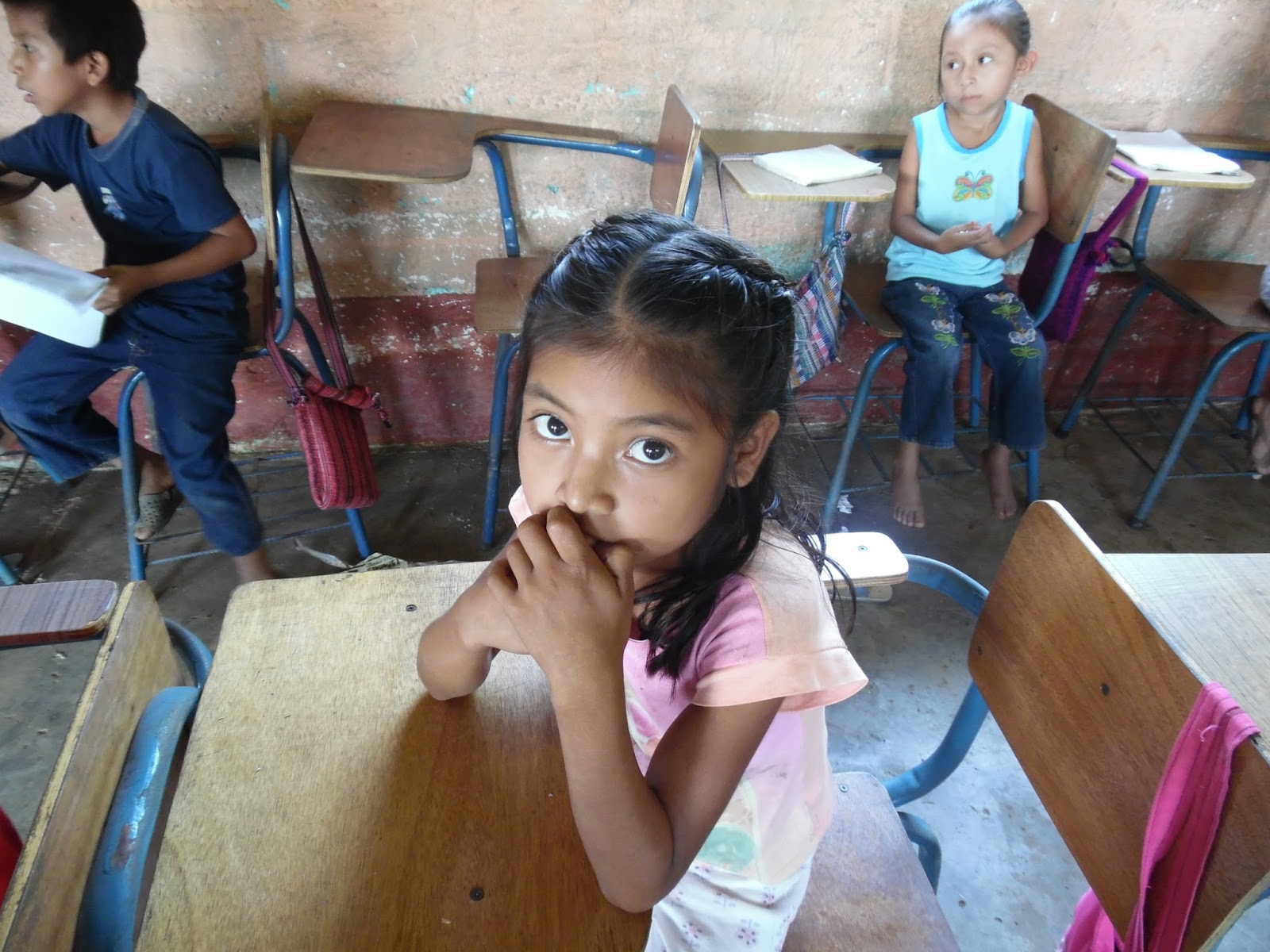
In order to gain new experiences, open my mind and see more of the world after finishing my studies, I left good old Germany for faraway Guatemala. I spend my first month in Antigua, a beautiful historical colonial city, to improve my very basic Spanish skills before I started my volunteership. In week four I had to say “¡Hasta la vista, Antigua!” and “¡Hola, Nueva Mercedes!”. Together with Katerina, Georgia and Patrick, my new house-mates and co-volunteers, we set off on the long journey crossing the whole of Guatemala to reach the little village. After a typical Guatemalan bus ride (a lot of fun for me!) through small streets, overfilled cars and many shaking bodies, the tropical heat and a stunning mountain landscape welcomed us – the motto here is “Natur Pur”. Our first stop before we saw our new house was the colourful Teleman market in order to refill the empty fridge at home and provide for our survival in the first week there. An inviting wooden hut will be our home for the next months to come. Spiders, lizards and toads received us in a friendly manner – although it takes some time to get used to. But in contrast to my worst fears, up until now I´ve only seen snakes and scorpions just from afar – and let´s hope it will stay that way! The following day,  we went on the first visit to our new workplace – the Nueva Mercedes primary school. Hundreds of big, dark round eyes stared at us accompanied by countless “¿Cómo te llamas?“  and ¡Bonito tu pelo!“.


 A very particular welcome indeed. 

Soon, the first encounters, a few games and conversations with the kids made it clear to me that there is potential here. And hopefully we can help to foster this potential at least in some of the kids. Unfortunately it is not always that easy. The Guatemalan way of life in many aspects is incomparable to the German or European one. Especially regarding education there is so much to be done. Poverty and complicated living conditions don´t make it any easier. But some motivated and engaged people, who I have had the privilege to get to know during this short time fill me with hope. Hope, that it is possible to make a difference if we work together – not only here in Guatemala but globally. And even if it´s not feasible here “die Welt einzureißen” (to change the world), I am still happy for every single smile I can bring to people´s faces. That´s why I am really looking forward to the next five months that I will be here.
Guatemala, here I am – show me what you´ve got!


 Georgia's first impressions:

Strongest first impression: the kids! Those little faces that took them about 2 minutes to get to know us and since then they did not hesitate at all to call our names and ask us to play with them. Even though the conditions at school are not easy, everyone is trying their best with the resources they have; the teachers, the kids, and us. And of course, it is worth it since you see after a while some results of your work. For example, at times, during our afternoon activities in the primary school, a few distracted kids, not interested in the ongoing group activity, ask for our help in doing their homework. I remember one kid who, the first time I asked him to write down what the teacher was saying, didn’t like it and made fun of it. However, after the third day he was already used to my presence and he started asking me to approve what he had written. Another example is that a few of them after finishing their exercise come to me before and after they show it to their teacher in order to get a big “¡Perfecto!” o “¡Muy bien!”. They really seem to enjoy that moment judging by their big “¡Gracías!” smiles. 


In general, I have really enjoyed my first days in Nueva Mercedes and even though it is sad that the school year is over in the second week of October,  I am looking forward to starting our projects and morning activities with the kids. Hopefully, there are going to be many of them. This is why we tried our best to get their attention, make them like our activities so that they are motivated to keep on coming to our extracurricular educational afternoon sessions where we make them discover the world!


Saturday, August 22, 2015

Secret Formula


All those weeks we were looking for a secret formula that would bring us closer to the children. It's not easy to organise afternoon activities. For several reasons. Firstly there is a wide range of kids from all the grades. Secondly, you never know how many of them will come. Each one has different needs and especially the youngest ones always try to get the volunteers' attention at all cost.


And then, one day we came to school at 3 pm, having prepared activities for 1st and 2nd grade. No-one showed up, there were only some boys playing football. So instead of doing what we prepared, we decided to think for a little what we would enjoy ourselves if we were them.
We remembered the most dynamic and interesting games from the days where there was no power in the universe that could make us go home before the sunset. 


We focused on building a team, on making all of us work together. As a result not only the boys, but we as well enjoyed spending the time there a lot. We taught them new games and they liked them so much that afterwards we finished they gathered around us asking for another activity. Even after we left we could see them playing the games they had just learnt. 


The next day they were already waiting for us. We took a string, held it 1.5 above the ground and asked them to cross it over to the other side. At first the children didn't seem to be so sure about the excercise but soon enough they came up with innovative ideas on how to do it. They were creative and helped each other. We also had a chance to observe their behaviour in a group.


Now, more than before they come to talk to us during the breaks at school. Step by step we gain their trust. From now on it'll be easier for us to work together on their curriculum. This week we learnt that we can only succeed in working with this community if our relationship with it is based on mutual trust and the willingness to understand each other despite of any communication difficulties. 


Thursday, July 23, 2015

Marta's first weeks in the shoes of a volunteer


I like looking at the photos Katerina took on my first day with kids. I didn't know anything about them, each of them was just a name I couldn't remember no matter how many times they would repeat it, couple of big brown eyes staring at me and a bunch of hands touching my skin. Now I'm starting to develop a special bond with them, I'm beginning to understand their way of working.


At this point I must tell you about a person that definitely marked my first weeks in Mercedes. It was one of the girls from the first grade. The first time I met her, we started working on maths and I had real difficulty in explaining simplest equations to her. Then, the next day I spent an hour trying to teach her how to write a letter 'e'. No matter how many times she repeated it after me, she couldn't get it. I felt horibly frustrated for the first and the last time during my experience so far. I couldn't understand why something so obvious to me, was so difficult for her. Now I've been working at school for the last three weeks and although the girl still has problems with 'e', we became friends.


Now I understand that the kids' learning environment is completely different to the one I was studying in. The teachers often let them go earlier than they should, the breaks are longer for no reason at all, the classes sometimes don't take place at all. Besides, the children are often undernourished and unable to focus on a subject. But also, for example, the desks are designed for the right-handed people and the left-handed ones, like the girl I was talking about before, find it harder to adjust to that. Assisting at school requires huge amounts of patience and understanding.
What I find important is the ability to forget about oneself while working with children. Bringing problems and miseries to the classroom makes it extra hard to help them efficiently. And what are the problems the volunteers have to deal with? Water and power cuts, colonies of ants, tropical animals, and the most importantly, longing for all the places we call home and all the people we love.
The village is very small and apart from a school and a church, there is nothing else there. This means that what we can do in the evenings is limited to spending time at home, reading books, watching movies and talking. Moreover, it is hard to become considered part of the community by local people. They speak Q'eqch'i and sometimes I get the impression that because of our cultures being so different, they don't think much of two european girls who don't understand them and their life and ask for help with problems, that make up a part of their everyday life. But, this is also one of the reasons why i came here. I realise this is a unique opportunity for me to get experience in the field I'd like to work in in the future, which is teaching, to live in a reality completely different to the one I have lived in all my life, to develop my language skills and to grow as a person.
Despite of all the difficulties, I've never regretted coming here and I doubt I ever will. Everyday life in Mercedes takes a lot from you, but it gives you much, much more than you could ask for.

Tuesday, June 30, 2015

Vittoria's story: Picking up the loose threads


One important story which deserves an explanation is Vittoria's brief but very memorable 6 weeks involvement with Li Ch'utam and her contribution to the weaving project launched by Nicoline's team last year. Vittoria is a talented young Italian bag designer from London who came to volunteer for us at the end of April with the aim of focusing on the textiles workshop. 

The idea was to share her expertise in bag design with Mercedes women in order to create an original product of professional quality combining Maya weaving tradition and innovation which could be sold on the national or even international market for a decent price to help their makers make ends meet at the end of the month.

She took total ownership of the project straight away and the truth is that she did a fantastic job of it. At least, the part which concerned her and which she could influence. From dusk till dawn, the volunteers' house was filled with colourful threads, paintings of exotic birds, notebooks with design sketches, crayons, watercolours, wood cuttings, an array of special instruments to cut leather of which I couldn't name a single one... It was truly impressive to observe a real artist at work! Besides, her presence here brought a lovely touch to the house itself: she transformed empty wine bottles into exquisitely decorated candle holders, a fresh and tastefully arranged bouquet of flowers appeared on the table every week, and everything – candy wrappers, crisp packets, glass bottles and every piece of matter imaginable which you and I would classify as "trash" – was collected by her and recycled into something useful, worthy or simply beautiful.

She once referred to herself as "ghost volunteer" for the short duration of her stay, but she was much more vivid and important to myself and to Li Ch'utam than she believes.

As for the weaving workshop, despite her tireless efforts, things didn't quite work out as we had planned... Vittoria left us on Tuesday 9th June. Below is an explanation in her own words as to why:
 

"After months of dreaming about it, there it was, the 5th of March, flying to Guatemala, excited and happy to start a new experience. I had everything set up in my mind about how I wanted to organize what was going to be a handbags making workshop in Nueva Mercedes. The basics to start from had already been put in place by Nicoline and Kinga with the weaving workshop. 

Yes, I was thrilled by the idea of carrying on with the textiles and making a few nice bag pieces, possibly mixed with leather, different from the ones they were used to making. This would have been a great challenge for me, both personal and professional. I had finally quit my job in London, after four years of handbag design, to temporarily free myself from the “strict” European society, discover and immerge in a different culture and, most of all, to do something meaningful by sharing what I have learned during my years of work. 


According to the initial plan, I should have started the volunteership with another volunteer at the end of March, with the prospect of having another team player after few weeks. I had all the time beforehand to collect materials, machines and tools while being in Antigua.

And there we go, me in Antigua, cheerful and serene, had to re-think over the whole plan after the last minute bomb: the two compañeros I should have to start with dropped out of the volunteering. Li Ch'utam administration team was in urgent search for a good candidate to take over the positions.

Three weeks passed by and no news, I was starting to doubt that the project and the volunteering itself were going to happen.

At the end of the month I’ve been told that, yes, we were going to start. Katerina will have arrived to Guatemala at the end of April. Wonderful!

No additional help though, at least for next couple of months. This meant that the time I could have spent on the project was very limited as the main support of Li Ch'utam is of course directed towards assistance in kid’s education. 


I decided then to wait to be in Nueva Mercedes and see how to proceed once settled down.
Welcome to Mercedes! The most remote and magic place I have ever been in my life. Breathtaking landscapes in which the Q'eqchi community is quietly immersed, living a simple life, men working in fields and plantations and women looking after the house and their unquantifiable number of children. The overwhelming nature, the simple but intense life, the kids with their unlimited energies, and mostly the first steps to re-start the engine of the organization, which was left in stand-by for two months, made my first two weeks fly by without noticing. 

At the start I had limited time to dedicate to the project, on the little spare time of the week I’ve begun to involve in my ideas Imelda and Maria Elena, the only two women in the village that actually can weave without problems. 


They were on board, willing to learn something new, enthusiastic about new input, new textile’s colors and so on. I was again really REALLY excited, with lots of ideas of what we could do, using the resources that we had, wood for example. A “world” opened in my mind after I have seen the carpentry and met Emilio, the carpinter of Nueva Mercedes finca. I wanted so much to use wood. Parallel to the excitement I have to admit that I soon started feeling also limited and frustrated, I wanted to spend more time on this new project, elaborate and create an order in my mind, a plan of action to follow with the women.


Finally, after the first two weeks while I was dividing myself between school, afternoon activities and the project, I got the time I wanted. Ready to focus and to start being productive for real. The objective was to get done in more or less two weeks time one/two styles of bags, to bring them with me to Antigua and see if there was a chance to sell them on the market there. I soon realized that my dream to stick with this sort of timeline was one big utopia. The main reasons were the impossibility to have a real workspace to make trials and tests materials. Women seemed to not give any priority to the workshop even when we agreed on days to meet to work on we were always ending up postponing or canceling. 


The working hours averages per week were still the same as before, just too little. We always worked at Imelda's place as for her it wasn't possible to leave the house because of course she couldn’t leave alone her kids. We were working with little "spectators" all the time, which were taking away lots of energy and concentration. 


Kids running around, climbing on you, touching and playing with what was catching their attention (this means everything, including the curls of my hair). I tried to do the best I could, being at their disposition whenever they were available, being flexible as I didn’t want to impose any deadline. I completely respect them with their daily routine and family obligations. I was often ending up doing things by myself at home in order to experiment, save time and proceed with what was possible. Until I realized that this wasn’t the purpose of a workshop and with the little time at disposition left we would have not been able to achieve the objective of this project. In a month and a half time what we achieved in total were three pieces of weaved textiles, from which only one was done precisely and could be adapted to a bag to be used.


 After analyzing all these different aspects I got to the conclusion that surely I have been too optimistic to dream of creating a little bags production out of the blue in such a short time. Something that, now I know, requires a better structure with stronger capacity of influencing women. It has to be a long-term program, built up with patience, no restrictions of time and a bigger team to work with. I should have known all these things before but I have instead had to put my hands on it and hit my head before having it entirely clear. 


Conclusion? I am happy I did it. I don’t consider it as a waste of time but as a trial that still brought some awareness and some additional skills to the women's work. In the end I did manage to teach them something, even if just a little! I left them with guidelines to complete the three bags in their own time and with the freedom to make changes, so now I’m waiting to see their fruits! They also seemed willing to continue weaving new textiles following my proposal of color-combinations that they loved while working together. I would love to keep being involved in this matter and communicate with them from abroad. Apart from the “failure” of the project it has been a wonderful experience, I loved spending my time with Imelda and Maria Elena’s, being absorbed in their quotidian life and family dynamic. Trying to establish confidence and trust with them and the kids and become less extraneous day after day.  


Katerina knows well what I am referring to, we shared our ups and downs and tried our best to be supportive to each other. Sometimes it worked and sometimes it did not. I really want to thank her for the patience and kindness always showed during this period, it has been a pleasure working side by side with her.
 
It has been a short and intense life experience, I wish I could have done better but I am also a human with my million of limits. We sometimes have to accept these limits!"

- Vittoria Wuhrer


To conclude on the topic, I wanted to share a brief conversation with a woman from the village named Alba, who I went to visit a couple of days after Vittoria left. I told her about the project, about our struggles and the obstacles we faced, and why in the end it did not work out. She seemed surprised that we didn't ask more women to join in, that we did not try to create a bigger community around this workshop. "If you would have told me about it, she said, perhaps I would have found the time to participate too." She told me that the more women join, the better, because one can hardly find the motivation to take time out of their busy daily schedules to dedicate to something so intense and technically demanding. "Together, we would motivate each other", she told me, "and if one woman fails, there will be 5 others to encourage her and convince her that the fruits of her labour are worth it."

Li Ch'utam means "coming together" in Qeqch'i. How could we forget? The answer seems so obvious now that Alba has said it. Perhaps this was our mistake: forgetting the true meaning of the word "Li Ch'utam".


Monday, June 29, 2015

Back after the break


It's a long stretch from February to June, and the silence of the Lichutam blog which the spans over that period has been equally long. 
 

Since the last blog post, a lot has changed. For a start, the team has been entirely renewed: Nicoline, Kinga and Michel said their goodbyes to Mercedes some four months ago, and the new volunteers, Vittoria and myself (Katerina) only came at the end of April. This is part of the reason why the communication on this blog has not been functionning all that smoothly since then. It appears that the Lichutam tradition up until now has been for previous volunteers to post a little welcome note to introduce the new recruits. But in our case, we arrived to an empty house two and a half months after the last of the volunteers left, and had to make do with a self-welcome! Luckily enough, in our second week Nicoline, who was still in Guatemala, found the time to come back to El Polochic for 5 days and give us a much needed and much appreciated crash course on how to survive in Nueva Mercedes wilderness. :)


The idea of coming here and taking things over after a two months gap was somewhat unsettling: would the uninhabited volunteer's house be overgrown with vegetation and swarming with insects and forest creatures who will have had the time to nest there in the absence of humans? Would the long break weaken Lichutam's connection with the community? Were the kids at school still eagerly waiting for new volunteers to arrive? It turns out our fears were totally groundless. The house was in a perfect condition (only had to kick out one cheeky snake sleeping under a dusty cardboard box in the corner of the living room!), the teachers and the kids opened their doors for us at the primary school, and from the very first day the question that we get asked the most is "Hoy, computación a las tres?" meaning "Will there be afternoon activities today at 3PM?". Nothing seemed to be lost, and no bond broken. We came into a community which seemed genuinely happy to have Lichutam back.


For the first two weeks, despite a thorough introduction and everyday interaction with the kids who ask us to repeat our names every ten minutes or so, every time we passed by a house in the village, we heard children's excited voices shout "Kinga! Nicolina! Kinga! Nicolina!". To me, that is an unmistakable sign that the previous team left a real long-lasting impression in Mercedes people's hearts and minds. This, the "actividades a las tres" engraved in the kid's memories, and the fact that for the vast majority of Mercedians the name "Lichutam" needs no further explanation makes us aware of the real legacy that has been left behind by previous generations of volunteers. A legacy that we come to inherit, and that we could not be more grateful for. 
 

Since our arrival at the end of April, much has been done to honour that legacy and to set the wheels of Li Ch'utam back in motion. We started by taking up the 5 backbone projects from where the last volunteer team had left them. 


First and foremost, supporting teachers in Nueva Mercedes primary school during their morning lessons. Following the explicit desire of the teachers, we gave our attention to the lower grades (1st and 2nd) which are those who require the most care. After all, acquiring numeracy and literacy skills is the unquestionable foundation of education without which a pupil cannot proceed to the next level. 


Secondly, extracurricular afternoon activities with all those children who ask us everyday "Hoy, computación a las tres?". If truth be told, this has turned out much more challenging than we expected: with an unpredictable number of kids who come every day, of all age categories spanning all 6 grades, it is mpossible to plan classes out properly. Most of the time, we ended up with an unmanageable number of hyperactive children zooming around the classroom or the field in desperate search of our individual attention. Even sitting them down or quitening them up to explain the rules of the game we were about to play required a Herculean effort. We figured out very soon that imposing European/Western classroom discipline on these kids was like trying to teach horses to juggle with coconuts. 
 

And we gave up. Chaos it is! If we can only occupy 10 children at a time, while the others run around playing with their classmates, so be it! If we have to individually repeat the same information to every single child who didn't listen to instructions (so, all, basically), so be it! Patience, patience and more patience, my friends, that is the only magic formula... Having said that, the amazing thing about these children is that once they have your attention, they will absorb anything and evertyhing you teach them. They are impatient but also eager to learn, they are excessively energetic but will put their heart into any game that you propose to them. They want to be with us. They want to play with us, they want to learn things from us. And that is a delightful and fufilling feeling worth every troublemaker's mischief in the world!


Third, computer literacy classes with básico students from La Constancia. At the beginning of May, we got to meet the director of La Constancia secondary school, Maximiliano, who stressed his urgent need for students to have ICT classes as soon as possible. Just imagine: computación is a compulsory part of the National Secondary School Curriculum, and La Constancia did not have up until now a single computer, let alone at IT teacher to deliver the classes. Lichutam took over in 2014, tutoring all of La Constancia's students (around 40 in total) in intensive 4h sessions 2 times a month. Since then, La Constancia expanded and now has over 70 pupils. After considerable efforts, Maximiliano managed to obtain access to some 10 computers through partnerships and donations , and has hired an ICT teacher. But 10 computers and 1 teacher for 70 kids is nowhere near enough. Therefore, Lichutam has proposed to continue the tutoring of 20 básico students living in Nueva Mercedes. So far, this has been working very well and the students receive 1h30 of weekly computer literacy classes.


Fourth is the scholarships project. Apart from Li Ch'utam's long running Básico scholarships currently supporting 19 students from 17 families, we have initiated a new scholarship to encourage young and talented Diversificado (high school) pupils from Nueva Mercedes. At the moment, Mercedes has 4 scholarship candidates, three boys and one girl. Two of them live in the village but travel to the nearby town of Senahú, and the other two are in the regional centre of Alta Verapaz, as far as 4 hours away from their home in El Polochic. This means considerable transport and accommodation costs for all 4. The applicants will receive 250Q to support them with these and other expenses (enrolment, monthly fees, materials, uniforms, etc.). As with the básico scholarships, we expect the word to spread fast and wide, and the fruits to be ready to harvest as soon as next year. When the villagers get wind of Li Ch'utams support offered to those willing to pursue education further, parents are bound to encourage their children to follow the same path, and as in the case with secondary school students, the growth will be exponential. This year we have 4 Mercedian kids in diversificado. Next year, we might have the double of that. And so on! We, certainly, will put all our hopes and efforts into materialising this dream.


Last but not least, the fifth project that we relaunched with the help of Vittoria Wuhrer was the weaving workshop. It was a beautiful beginning full of hope and aspirations, which for various complex reasons didn't work out the way we had planned.

But this post is dense enough already, and Vittoria's story of picking up the loose threads in Nueva Mercedes deserves its own separate space. So, this will be Chapter 2 of "catching up after a long absence" blogpost.

Monday, February 16, 2015

Goodbye and thank you to Kinga


This morning at 6 o’clock the second to last member of the current team here in Nueva Mercedes left on a pickup truck. Kinga spend five months here in Mercedes, and during her time participated in and organized, among other things, English lessons for young kids, computer classes for the men, weaving workshops for the women and of course, our every-day lessons with the primary school kids.
The kids are already starting to ask about when she will be back, and the house is very empty to come home to just like the work is a little less fun alone.

.
 Thank you Kinga for the time spend together, You will be missed!


Bantiox!


Thursday, January 22, 2015

New Year Clean Start

The new school year began Monday, and Friday morning volunteers, students and parents met to clean the school to have everything ready for the new year.
A lot of dust had been gathering during the two-month vacation, so the help of everybody was needed. Old or broken things were thrown away and new books and materials given out to the students who were mostly very excited to begin classes.
Monday morning at 8 classes then begun, we spend the first days in kinder garden and will now spend a couple of days in each grade with each teacher to be able to evaluate where our help is most needed.
In the fourth grade classroom the furniture unfortunately did not make it through the vacation and there are no chairs or tables. This is obviously a big problem and Li Ch’utam will together with the teachers try to find a solution to this problem as fast as possible so the fourth graders can have proper lessons along with every-one else.


The school was cleaned thoroughly both inside and outside!

Some of the boys decided to take a break from cleaning and play some music instead


Handing out materials for the new school year


With the beginning of the new school year we have also had to say goodbye to Michell, who has been here with us since September. It is strange to be just the two of us in the house now, and both Kinga and I would like to send a big thank you to Michell for the time spend living and working together!

Here are a couple of pictures from Michell's time in Nueva Mercedes: